GeoMantle
WaveBack · version 1.3.1

How fast was the wave?
Read it from the sand.

WaveBack estimates the flow speed, depth and run-up of a tsunami from the thickness and grain size of the deposit it left. It runs established inverse and run-up models, checks the results before you interpret them, and writes the methods and results paragraphs. No coding, and it runs offline in your browser.

Jaffe and Gelfenbaum (2007) inversionModern and paleotsunami depositsTakes grain-size tables from GrainLabMethods and results paragraphs
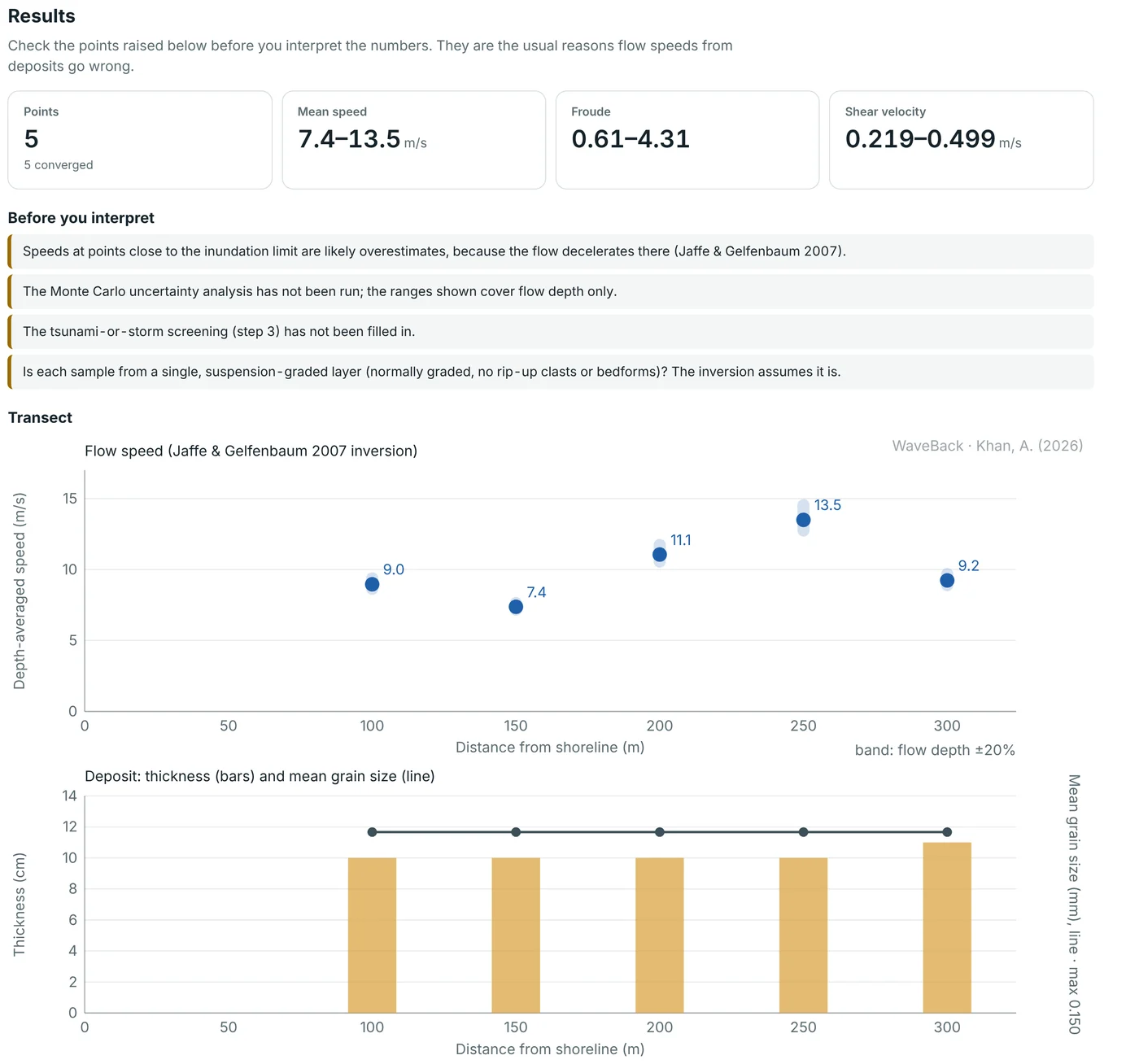
Flow speed along a transect, from the published benchmark deposit
WaveBack results: flow speed along a transect with deposit thickness and grain size
What it does

From a sand layer to a flow speed you can defend

Seven steps: Project, Deposits, Origin, Flow speed, Run-up and checks, Results and Export. The published benchmark of Jaffe and Gelfenbaum (2007) is built in as a demo.

Flow speed from deposits

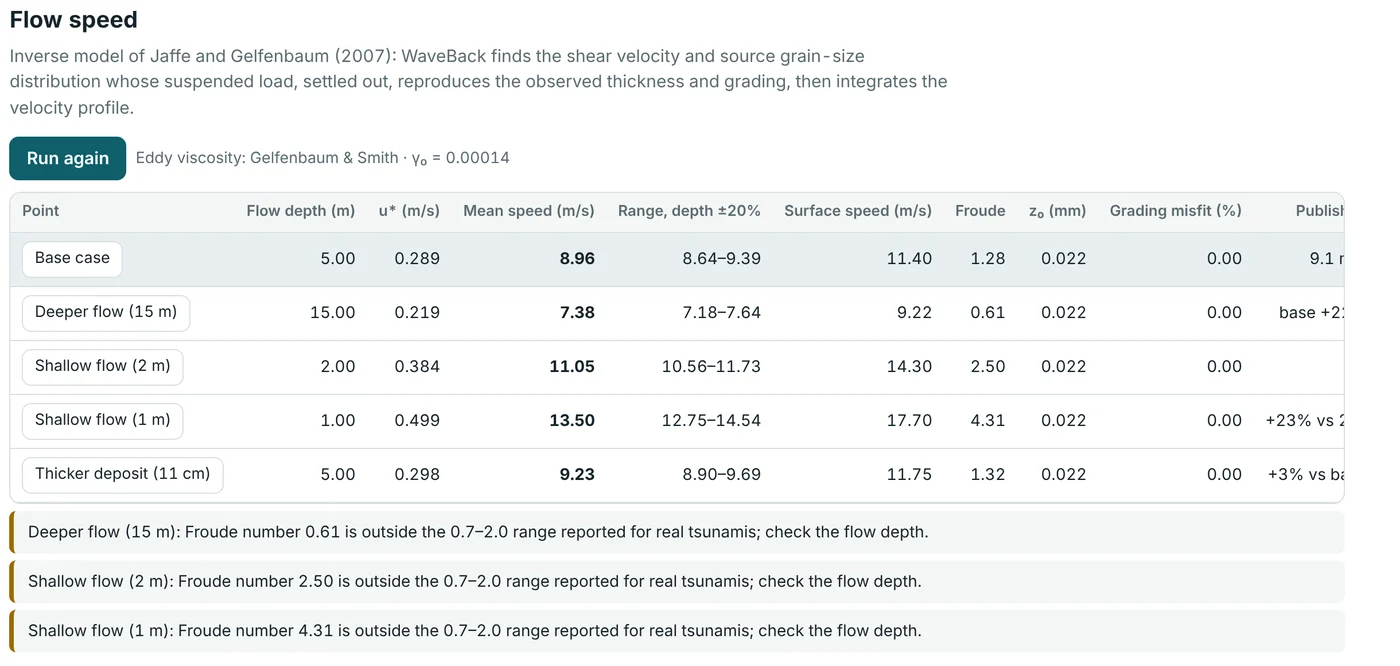
WaveBack uses the inverse model of Jaffe and Gelfenbaum (2007): it finds the shear velocity and source grain-size distribution whose suspended load, settled out, reproduces the observed thickness and grading, then integrates the velocity profile.

  • Gelfenbaum and Smith (1986), parabolic or linear eddy viscosity
  • Unknown flow depth solved from a Froude number, or flow depth ± a percentage
  • Froude checks flag speeds outside the range reported for real tsunamis
WaveBack flow-speed table with Froude checks

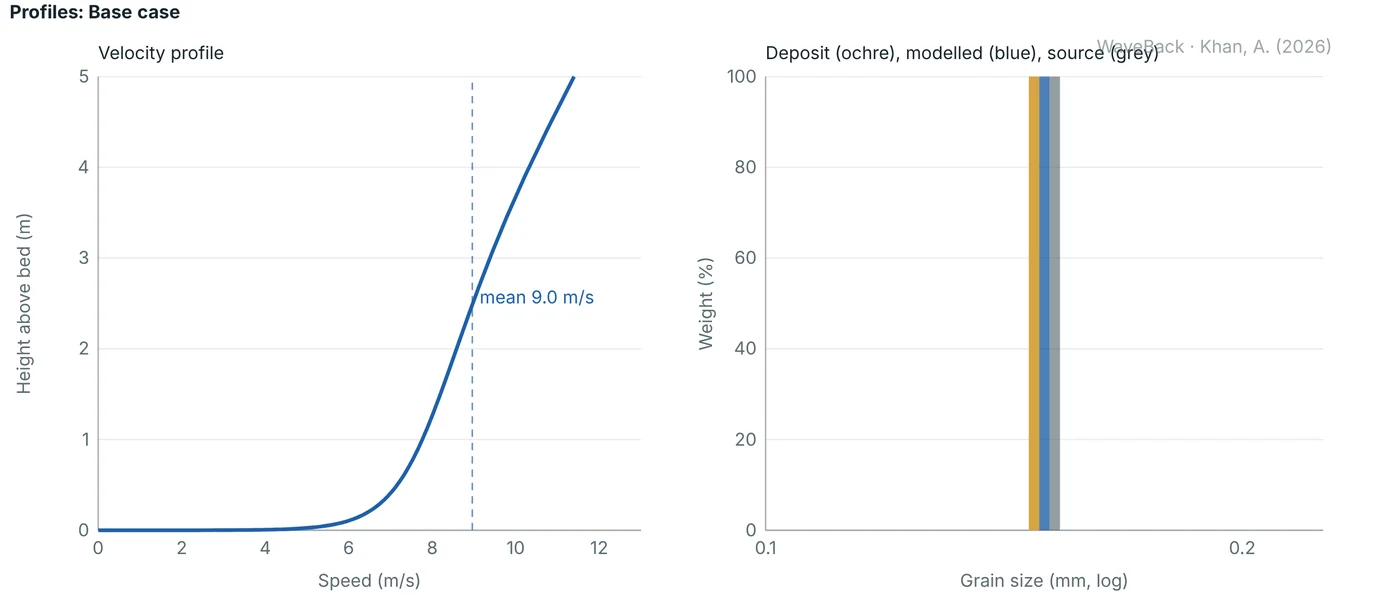
Velocity profile and deposit match

For every sampling point you see the velocity profile through the flow and how the modelled deposit compares with the observed one, so you can judge each inversion rather than trust a single number.

Velocity profile and modelled versus observed deposit

Run-up, paleotsunami settings and checks

The advection model of Moore et al. (2007) gives a minimum speed, and the sediment run-up model of Soulsby et al. (2007) places the water's landward limit. For older deposits, a compaction correction and a mud cut-off keep the inversion realistic. Before you interpret, WaveBack lists the conditions that most often make flow speeds wrong.

WaveBack results with checks before interpretation
WaveBack Pro

Is it really a tsunami, and how certain is the speed?

Pro adds the evidence and uncertainty that reviewers ask for.

Tsunami or storm screening PRO

29 sedimentary, microfossil, heavy-mineral, lake, boulder-field and offshore criteria and 10 wave and flow characteristics, each with its published tsunami and storm ranges and its source. Your data suggest answers that count only after you confirm them. The result is a leaning, never a verdict.

Monte Carlo uncertainty PRO

Hundreds of reruns per point, varying thickness, flow depth, grain size, the resuspension coefficient and bed concentration together: median speed and Froude number with 95% ranges, histograms and a reproducible seed.

Ground profile and water surface PRO

Flow depth at each point from a surveyed ground profile and a level or sloping water surface, so depth no longer has to come from an assumed Froude number; run-up height at the inundation limit.

Boulder transport PRO

Minimum flow speed to slide, overturn or lift a boulder after Nandasena et al. (2011), with the full-weight option of Bressan et al. (2018), without converting it into wave heights.

Compare editions

Free does the analysis. Pro goes further.

FeatureFreePro
Flow speed inversion (Jaffe and Gelfenbaum 2007), three eddy-viscosity profiles✓✓
Flow depth from a Froude number or a depth range✓✓
Moore et al. (2007) advection and Soulsby et al. (2007) run-up✓✓
Compaction correction and mud cut-off for paleotsunami deposits✓✓
Checks before interpretation; methods and results paragraphs✓✓
CSV, SVG and PNG exports; project files✓✓
Tsunami or storm screening: 29 criteria and 10 wave and flow characteristics–✓
Boulder transport (Nandasena et al. 2011)–✓
Monte Carlo uncertainty with 95% ranges and histograms–✓
Ground profile and water surface; run-up height–✓
Pricing

Simple, one-time pricing

No subscription. Buy once and keep it.

WaveBack Free

$0

Free for research and teaching (CC BY-ND 4.0)

  • Flow speed, depth and run-up from deposits
  • Paleotsunami settings
  • Benchmark demo and user guide
  • Methods and results paragraphs
Download WaveBack Free (zip, 0.1 MB)

Also archived on Zenodo.

Most complete

WaveBack Pro

$99 USD, one-time

Single-user licence, use on all your own computers

  • Everything in Free
  • Tsunami or storm screening
  • Monte Carlo uncertainty
  • Ground profile and boulder transport
  • Free updates for all 1.x versions

🔒 Secure checkout by Paddle · 30-day money-back guarantee

Prices in US dollars; local taxes are added at checkout where applicable. Lab, department and teaching licences: contact us.

Validation

How WaveBack was checked

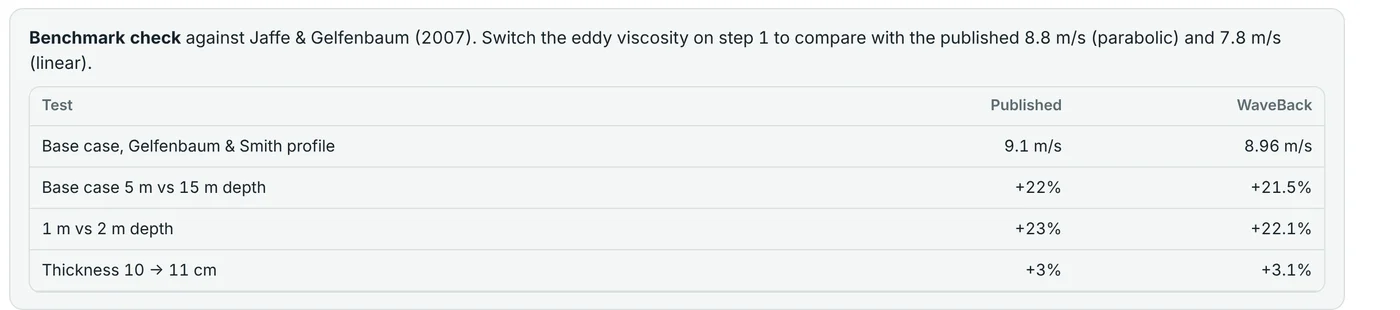
WaveBack reproduces the published benchmark and matches an independent implementation of the same equations.

8.96 m/s

Benchmark speed against the published 9.1 m/s of Jaffe and Gelfenbaum (2007), Gelfenbaum and Smith profile; 8.62 vs 8.8 (parabolic) and 7.67 vs 7.8 m/s (linear).

≤ 3 points

Sensitivity tests to flow depth, thickness and the resuspension coefficient agree with the published percentages.

4 × 10⁻¹⁵

Independent check: the largest relative difference from an independent Python implementation, Monte Carlo samples included.

1000 runs

Monte Carlo on the benchmark: every run converged; the same seed repeats the same medians and ranges.

Exact

Ground profile and boulder modules reproduce hand calculations for level and sloping water surfaces and for sliding, overturning and lifting.

Reviewed

Independent review before launch: every issue a separate tester found was fixed and re-tested in version 1.3.1.

WaveBack benchmark check against Jaffe and Gelfenbaum (2007)
Questions

Frequently asked questions

What do I need to run WaveBack?

A recent desktop browser: Chrome, Edge or Firefox. There is nothing to install and no internet connection is needed, and no data leaves your computer.

What data do I enter?

For each sampling point: distance from the shoreline, deposit thickness, flow depth if known, and the grain-size distribution of the deposit. Grain-size tables can be pasted straight from GrainLab.

Does WaveBack decide whether my deposit is from a tsunami?

No. The Pro screening tallies published criteria and gives a leaning: tsunami, storm or inconclusive. It supports, and does not replace, the judgment of a specialist.

How do I receive WaveBack Pro?

After payment you receive a download link by email with the software, the user guide, the README and the validation notes. Paddle also emails your receipt.

Can I get a refund?

Yes. Ask within 30 days of purchase for a full refund. See the Refund Policy.

How should I cite WaveBack?

Cite the version you used, and the methods and standards listed by the software.

Khan, A. (2026). WaveBack: tsunami flow speed, depth and run-up from tsunami deposits, version 1.3.1 [Computer software]. Zenodo. https://doi.org/10.5281/zenodo.24511298
Put a number on the wave

Start with the free edition and the built-in benchmark. Upgrade when you need screening and uncertainty.